

Inkle’s done it again. The UK-based company is one of my personal favorite studios – Heaven’s Vault, their space-boating archaeology sim, is arguably the most profound gaming experience I’ve had. The studio is just as comfortable working in an adaptation of Jules Verne’s Around the World in 80 Days as they are in murder-mysteries, Arthurian legends, and most recently, a perfectly charming walk through the Scottish highlands. Despite knowing this, their newest game, The Forever Labyrinth, took me completely by surprise.
The Forever Labyrinth is a rogue-lite mystery game; you are searching through an ever-shifting maze to find your missing friend, Professor Sheldrake. All she left you is a riddle, and a painting you can look deeper and deeper into until you get lost in it. Literally. You get transported to an impossible place, where paintings and concepts, not ordinary movement, reigns supreme. As the game progresses over several runs, you run into people from all time periods of human history swallowed by this labyrinth, and slowly unravel the mysteries of its “Source”.
Here’s the wrinkle, though – all the paintings in game are 100% real, and hosted on Google Arts & Culture. From Monet to Hiroshige, Ancient Egypt to outer space, a truly global body of art is replicated within the game’s maze.
For the uninitiated, Google Arts and Culture was founded in 2011 as a non-commercial branch of the company. It is meant to be a tool to assist museums in digitizing their own collection, teach people about art and science, and enable ways of interacting with history and art that aren’t possible with the physical objects.
In practice, this tends to mean very, very fancy slideshows. However, they do a lot of “Experiments,” shorter games that in some way interact with the materials hosted in Google Arts and Culture. Naturally, most of them are cheap puzzle games, endless runners, or AI “Remix” tools!
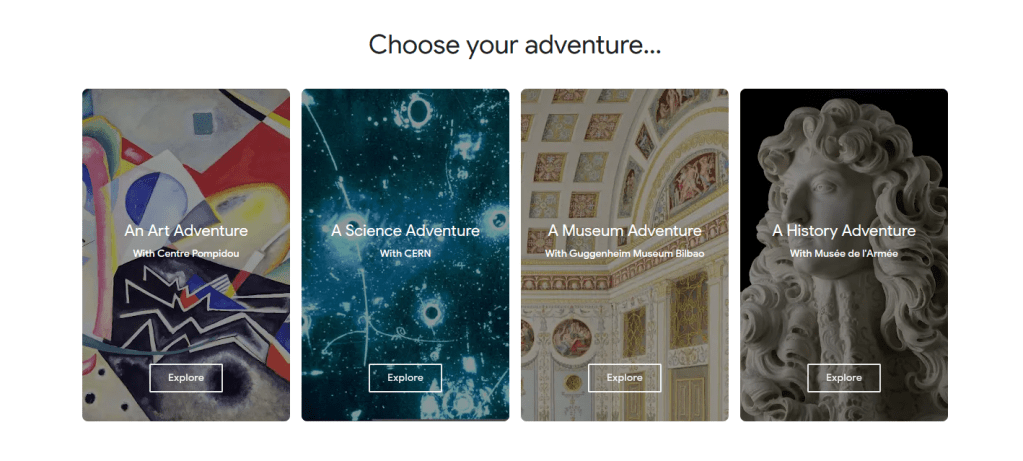
If it’s not obvious, I’m not a huge fan. It’s an amazing resource to compile thousands of museum collections into one space, but in practice it has a few issues. It’s not well-integrated with Google Images, it is hard to navigate, and it tends to feature stories by museums that are already well-known and well-supported – at the time of writing the featured “Stories” are by the Centre Pompidou (the French National Museum of Modern Art), CERN, the Guggenheim Bilbao, and the Musée de l’Armée.
Still, my issues with Google Arts and Culture did not stop me from going “What? Hell yeah! What?” when inkle announced The Forever Labyrinth. I was baffled. How would they use historical artworks? How does a narrative roguelite fit into Google Arts & Culture’s portfolio? How does Jon Ingold write so many games so quickly?
As it turns out, they did a great job with it.
Lots of videogames represent famous pieces of art in their virtual world. Sometimes they draw attention to it, like Horizon: Forbidden West does in Tilda’s Vault, and sometimes they pass without comment (to the delight, or confusion, of the observant). The Forever Labyrinth, though, has far and away the largest and most diverse collection of fine art to ever grace a virtual world.
Where the game truly shines, though, is that these aren’t artworks to be observed in silent reflection. Instead, the core movement of the game relies on 1) identifying compositional elements that are shared across multiple artworks and 2) chaining those compositions to reach desired spaces.
See, the game’s Labyrinth doesn’t really operate in Euclidean space. While rooms are largely connected, the game fearlessly demolishes itself around your ears if you try. Instead, the primary movement is from room to room. Each space, whether an Attic of Blooms or a Hedge Maze of Mountains contains a handful of artworks that all share that compositional element. As you find mementos and journal pages of other prisoners of the maze, you need to be able to identify what artworks appear in multiple rooms, and use their composition as a doorway!
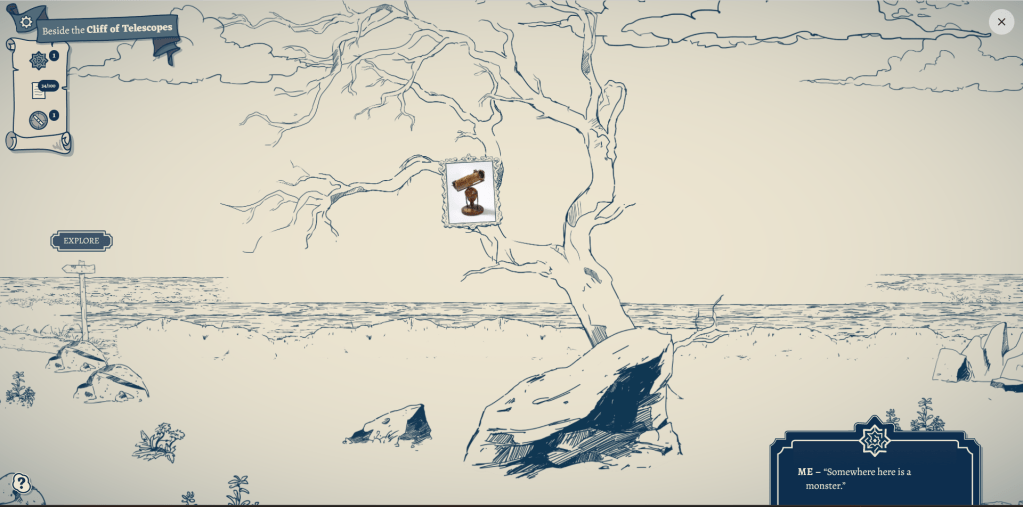
Jumping from painting to painting also buys the player more time. You are, from the moment you enter, being hunted by a monster, heralded by a bell. If you walk like a pleb, you are going to get caught, and end in failure. But, jumping through painting after painting manages to buy you more time. In one run, while trying to help out hopeless romantic and historical Mughal Emperor Shahab-ud-Din Muhammed Khurram, the route I discovered him from got destroyed, and it turned into a remarkably tense chase where I desperately searched for the only other painting i knew could get me back there while the bell grew closer and closer.
This is a fantastically clever system. In short, what inkle has managed to do is turn art criticism into gameplay. Identifying compositional elements and how they interact is one of the fundamental tools to study fine art! Playing the game is stealth learning, and they’ve got a knack for that – I didn’t think translating lost languages would make compelling gameplay either until I spent 8 hours straight doing just that in Heaven’s Vault.
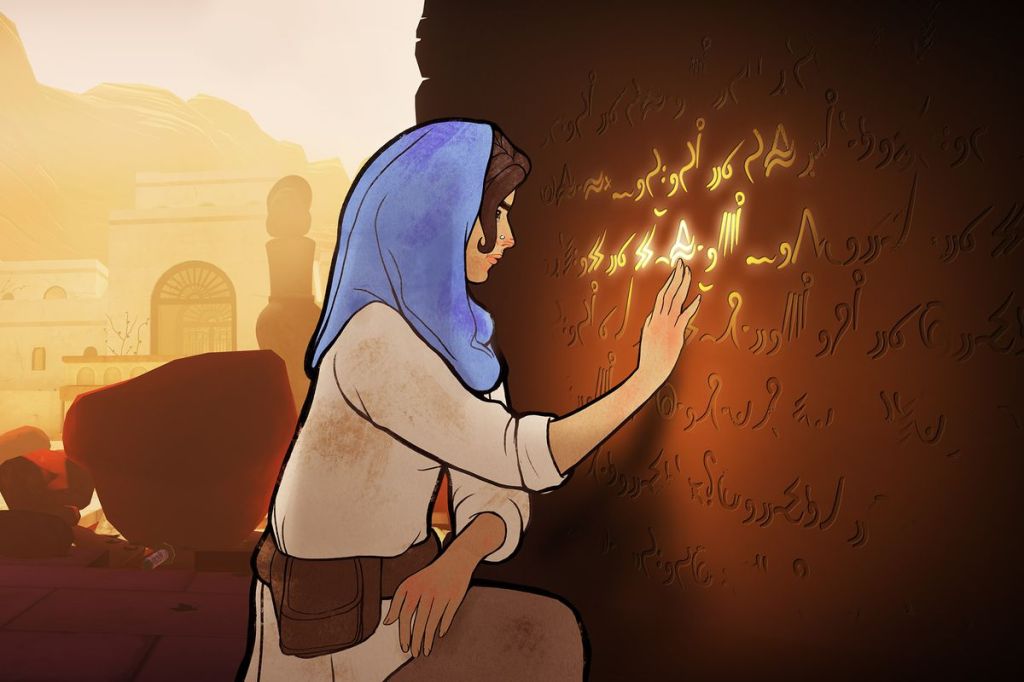
To further their teaching of art interpretation, the main character will occasionally ask about part of a painting. Is a yellow room pleasant to look at, or overwhelming? Is St Jerome happy with what he’s reading, or shocked? Just how odd is this sun… leg…. Thing? The player gets to decide, and from that get to build their own interpretation of the art.
This is amazing to me – I could easily see this game being used in a high school or undergraduate art survey, to great success. It is narratively compelling, showcases a ridiculously wide arrange of historical and contemporary art, and makes the act of play a tool of genuine learning, unlike the 80 different 12-piece puzzles on Google Arts and Culture.
I’m still baffled that a game like this can exist, but the gaming and art worlds are richer for it. Thanks, inkle.

Ludohistory is made possible only through viewer support. If you enjoyed this post and want to support the channel, please do consider joining on Patreon.
 Ludohistory
Leave a comment